
Reflections on Marathon Training

Entering grad school, I was ready to drop distance running after 10 years. At first blush, running is a one-dimensional sport. Yes, you can incorporate strength training and stretches, but the main input is running more miles at faster speeds. It's not technically expressive like tennis or soccer, where the best athletes are iconically distinct (think Nadal, Federer, Djokovic). If you watch professional distance running, the best athletes typically have the same perfect form.
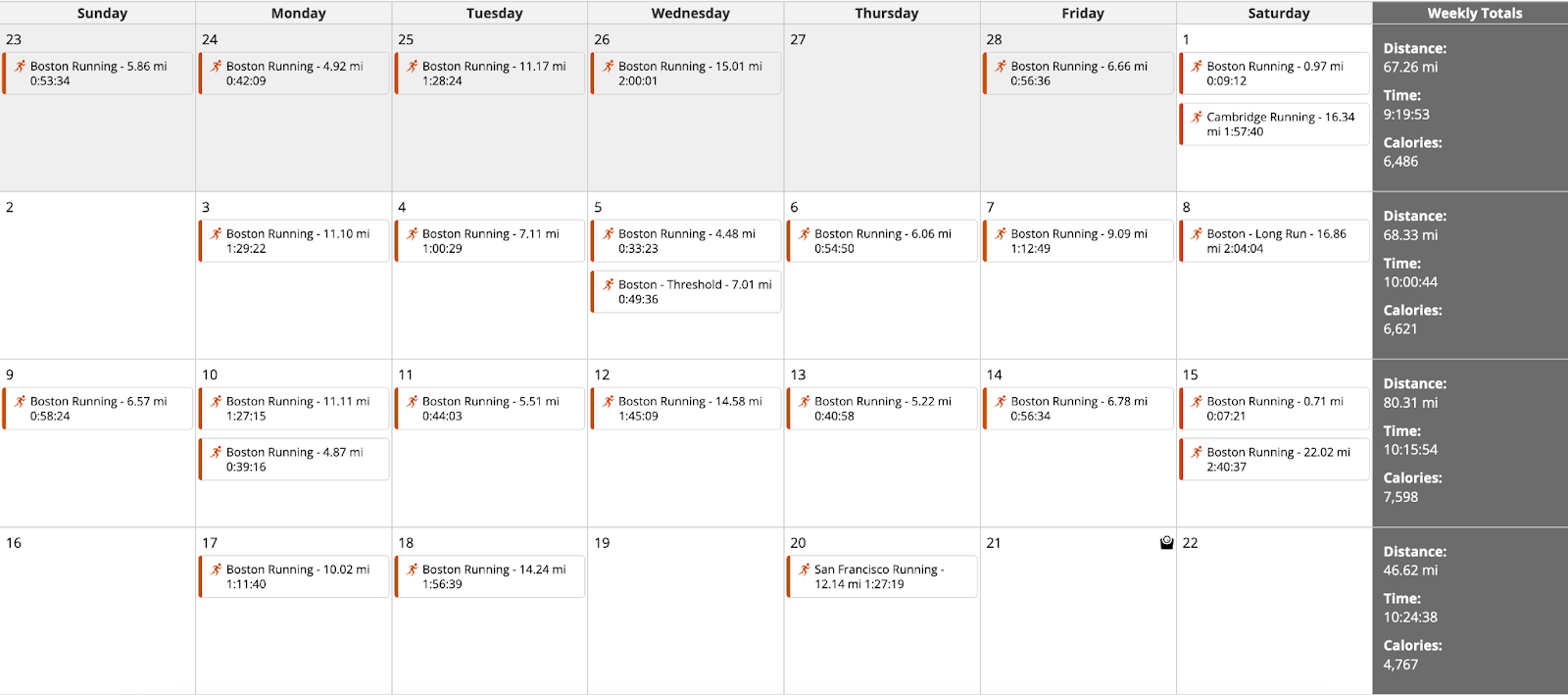
But the way different runners need to train is pretty personal, even if the goal is directionally the same. For my first marathon, I followed a 17-week plan that peaked at 70 miles per week with 3 workouts and 3 recovery runs every week. I typically ran 3-4% faster than goal pace on long runs while almost never hitting my VO2 max (5k pace) repeats. I started the plan aiming to run 3:10, and by week 10, I was expecting to go sub-3 based on my long runs. It's pretty clear that I developed different strengths compared to the athlete that the coach had in mind when creating the plan. Regardless, I felt happy and proud to improve far more in those four months of distance running than in any previous period of my life.
I signed up for the marathon during my second semester of grad school because I needed a strongly directional, time-bound goal outside of academics. Research progress often felt inconsistent while classes made incremental progress toward goals that were only indirectly aligned to what I wanted to accomplish in my PhD. Neither aspect had a physical instantiation of the output. To fill this want for reality, running was good. The output metrics are easy to measure week to week. My watch could track pace, cadence, heart rate, recovery, sleep, and allowed me to give a subjective rating of the difficulty of each workout. It forced me to be honest to myself about the quality of workouts and rest I was getting. It turned out that sleep discipline was more difficult than the 70 miles a week, but even so, I had a great morning schedule for about 3 months. One caveat to these measures was picking up an injury, which made it difficult to negotiate the right balance of recovery and pushing through training. I ended up needing nearly 2 months post-race to have my knee despite semi-consistent prevention and rehabilitation exercises throughout the entire process.
A difficult lesson I learned was the necessity of matching my training distribution to my race conditions. I did very little hill training, and my course had more elevation gain than Boston (it is the most difficult world major course due to hills). Over 80% of my training was at 30-40 F in the winter months, so I didn't practice drinking mid-run because I never got dehydrated. My May 4th race day was 67 F and humid. I walked at various points in the last 5 miles and felt scared of pushing to the point of heat exhaustion. It was the most difficult run I had done, not due to 4-6 extra miles compared to my long runs, but because the conditions were so out of distribution for my body.
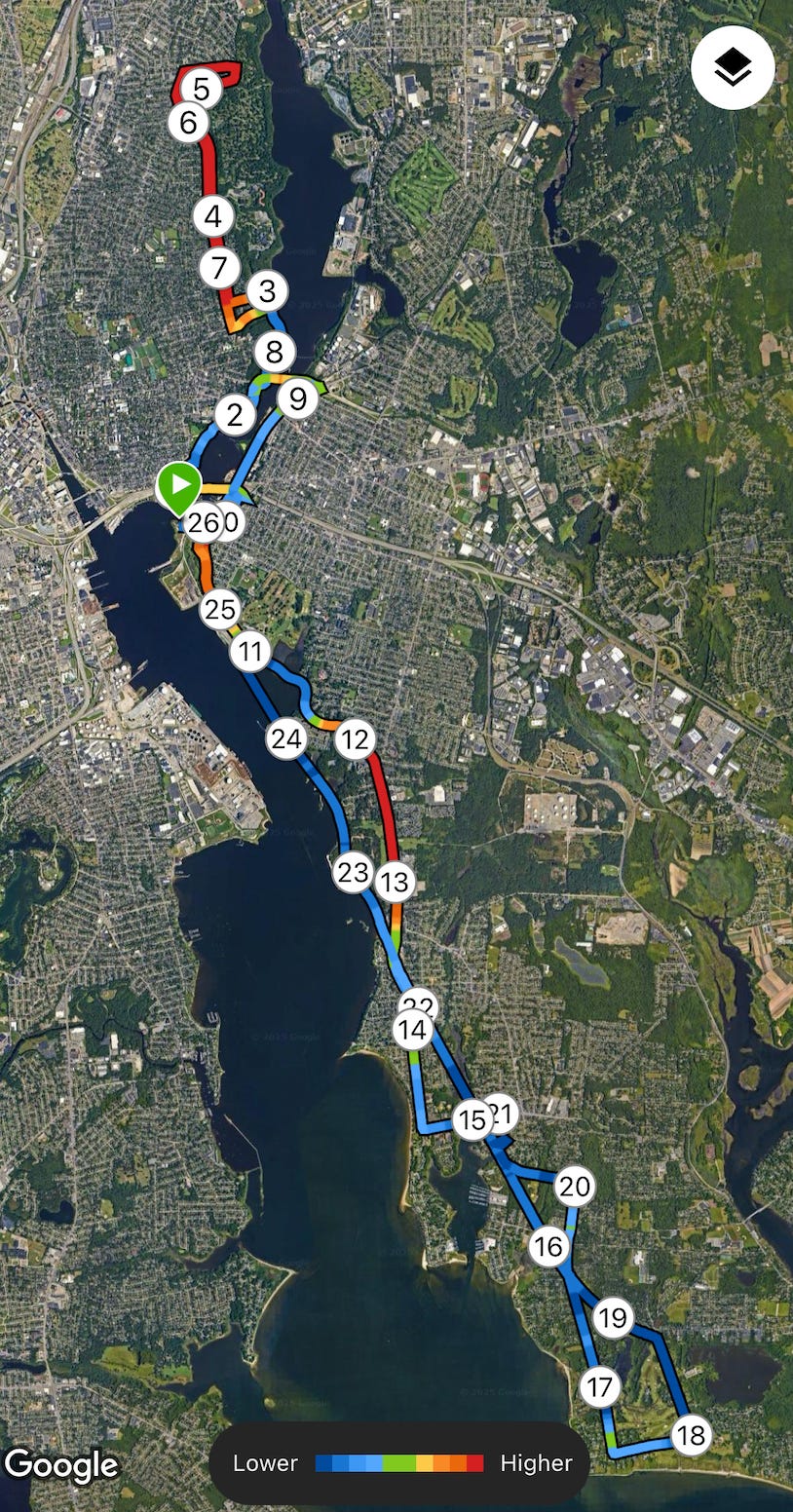
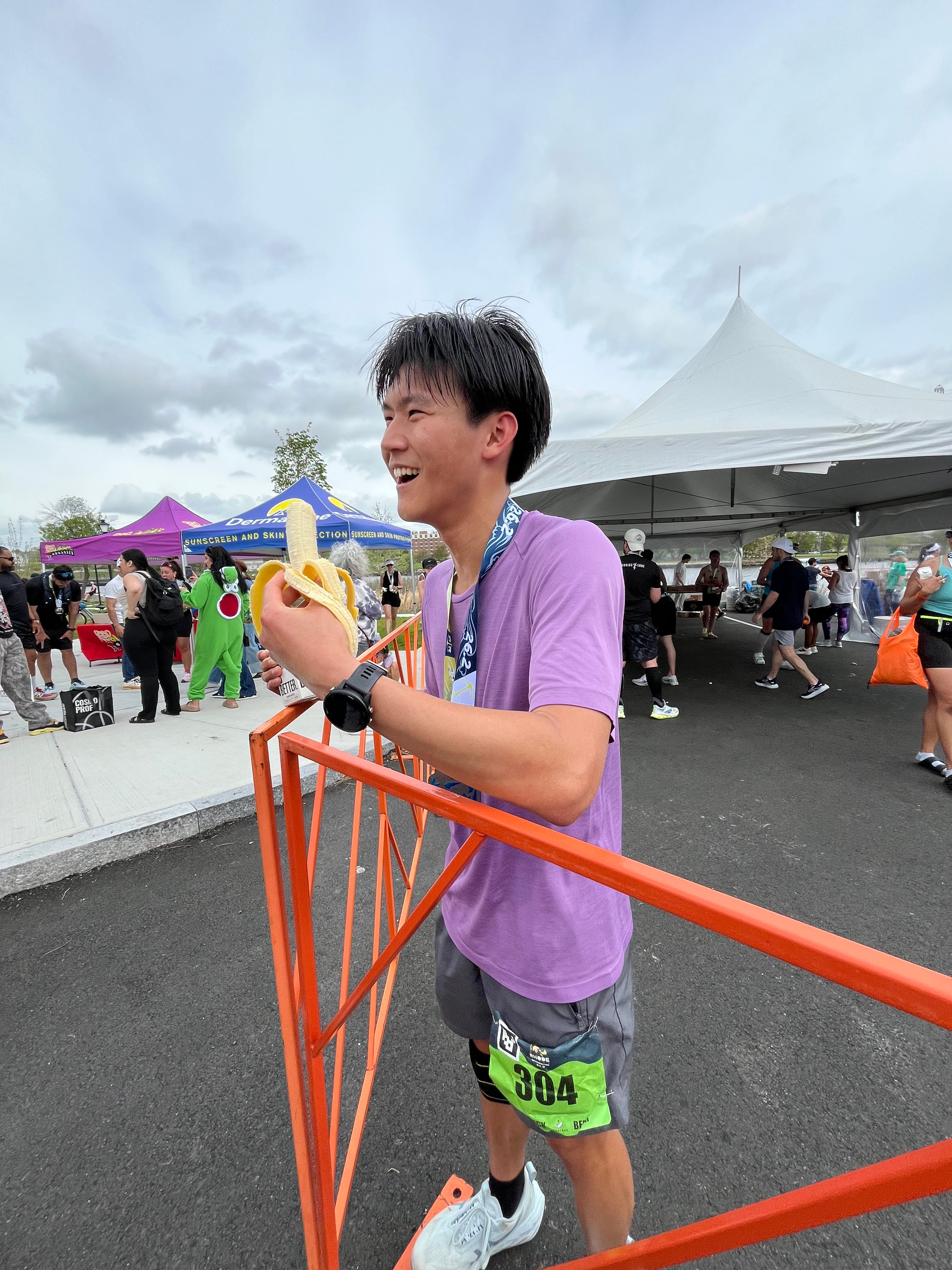
However, with preparation, marathons are pretty low variance. While most performances greatly depend on how I feel on the day (e.g. STEM contests, dance, tennis), there's no "choking" or miracle rally at a marathon distance. So, seeing my 3:09 finish, I didn't feel frustrated with myself, but I wasn't thrilled either. Having my two best friends and mom cheering for me at various points in the race felt very special (and emotionally necessary), but the race itself was just the hardest and longest run of the training plan. Reaching the endpoint of the longer training journey felt satisfying, especially since my plans were thrown off by random injuries and travel. Very hesitantly, I take this as evidence that I can accomplish other longer-term projects in my life (*cough, cough* PhD). I suppose training for a marathon is less one-dimensional than I thought!
Lastly, marathon training imposed useful structure on my life. To hit 70 miles a week, I had to block off 15+ hours. The only feasible schedule while working in labs was to sleep at 10:30 and wake up at 7. Because of the physical load, I needed more sleep to recover. Running constrained my time and freedom. But this constraint helped me feel more consistent and clear-headed week to week. Rather than being another "to-do" on my list and generating anxiety, training became an anchor to each day that was stabilizing, motivating, and oddly freeing. I think it was the first time I did something that took time but gave me the feeling of getting time back.
Epilogue
I took about a month off after the race to let my knee heal. Initially, I felt helpless as my hard-earned fitness evaporated away. I tried running some on the elliptical, but I couldn’t get over the hamster wheel feeling. A few weeks later, I finally bought a bouldering gym membership after years free-riding off of guest passes and started a new progress bar. More weeks pass, and I’ve slowly worked running back into my schedule. Now, I’m maintaining 50 miles per week with a hint of pain. I haven’t signed up for another marathon (yet), though my eye is on the Boston qualification time. But for now, it’s summer. It’s hot, and I can take things a little slower, with a little more softness. I know that when I need to, I will reinstate the structure of training to build back up to and then beyond where I was.
“I think it was the first time I did something that took time but gave me the feeling of getting time back.” -> this is so cool!!
banana!!